Tag: preschool curriculum

  • Helpful Ways To Support a Diversity-Rich Preschool Classroom

    Helpful Ways To Support a Diversity-Rich Preschool Classroom

    The golden hour to cultivate diversity is in preschoolers!

    Even in our modern-era, racial and cultural biases are still prevalent which makes teaching diversity and bringing awareness to this issue crucial for the developing preschooler. We know that after the age of nine racial and cultural attitudes tend to stay the same unless they have a life-altering experience. So the time spanning beforehand is a critical time to help children develop positive attitudes towards their own and peers’ racial and cultural identities.

    At Darlene’s Wee Care 4 Kids in Upper Darby, a diversity-rich classroom is a vital component to our preschool classroom. Join us in today’s post as we unpack and navigate racial and cultural issues and learn better ways to support a diversity-rich preschool classroom!
    The Time For Racial and Cultural Education is Now!

    Preschool-aged children are at the perfect time in their development to experience and learn more about their culture and the different cultures around them. Below we’ll touch on why creating positive attitudes and experiences towards diversity in early childhood is crucial for creating both citizens of the world and an inclusive culture all around.

    Children between the ages of 2 ½ and 3 years old begin to develop an awareness of feelings, ideas, and stereotypes about people and themselves.

    As preschoolers begin to interact with their world through people, the media, and their community it begins to shape their perceptions and judgments of what’s going on around them.

    Young children and preschoolers have the cognitive elasticity to un-do pre-shaped and pre-conditioned perceptions of others as they’re exposed to diversity and engage in meaningful cultural experiences.   

    The three factors listed above make a diversity-rich classroom imperative because distilled, you can help shape, mold, and educate a preschooler to have positive attitudes and actions towards racial and cultural diversity.

    So, where do you begin to teach racial and cultural diversity in the classroom?

    Begin by addressing diversity!

    Almost every aspect of a child’s early years including key aspects of diapering, feeding, and toilet training are influenced by cultural beliefs and values. How we talk to and interact with kids speaks to our cultural behaviors, and kids are keen to pick up on these. Kids absorb traditions, routines, cultures, languages, and racial or national identities.

    With this said, there are many ways to go about promoting and educating our children to thrive in an inclusive and diverse world.  

    How can we approach a sensitivity to different races and cultures to our classrooms and provide an environment that preschoolers can thrive in? Find out below!

    To make your classroom more diverse…

    • Have a vast and diverse classroom library – Begin to build or add to your classroom library by providing books that are inclusive of all races, religions, and cultures.
    • Diversify your crafting – Many teachers love to build bulletin boards and add decoration to their classrooms — ensure you’re creating things that represent multicultural children and reflect, in real time, the preschoolers you have.
    • Discuss diversity openly – Preschoolers will be the first ones to identify differences, so have an open conversation with them about both similarities and differences.

    It’s also vital to remove any material that promotes racial and cultural stereotypes and to quickly address any racist or culturally insensitive remarks or behaviors.  

    Cultivate Diversity

    Explore racial and cultural diversity in your classroom in real-time. Dive in and explore with your preschoolers everything that makes them who they are — from holidays they celebrate and delicious, traditional foods, to celebrating important historical movements and things unique to who they are.   

    Learn about a culturally responsive classroom. Oftentimes in a conventional preschool, those who are not native English speakers feel lost, overlooked, and pressured into quickly adapting to their new environment. Find activities that are inclusive and reflective of your classroom. Incorporate sayings or phrases in their native language and design a lesson around it.

    Teach preschoolers to be critical thinkers. Language and conversations play heavily into shaping their understanding of the world. So while you’re having circle time, reading time, or doing any activity for that matter — dialogue, talk, and converse with these tiny humans. When you ask questions and talk about things openly and honestly it helps them stay curious and pliable in their perceptions and judgments — nothing is yet solidified.  

    The best thing as a preschool educator is to be a role model for a culturally diverse classroom by being proactive in choosing activities and books that are inclusive and representative to all your students.

    Diversity is important to tackle early on in preschool because, at the root of it, people are different. When we’re able to give them the tools and language skills to empathetically embrace difficult issues, it creates an inclusive environment where we all can thrive!

    To learn more about our preschool curriculum, connect with us today!


  • 6 Educational Toys That Will Reinforce Learning At Home

    6 Educational Toys That Will Reinforce Learning At Home

    If you’re a parent, you’re probably tired of picking up toys. You’re probably also tired of seeing how quickly your child gets bored with their toys. When a toy is new, they’re fascinated for about 5 minutes, and suddenly, it’s old. What’s up with that? Maybe you’re even suspicious of buying toys at all because you just figure they’ll be one more thing to clutter up your space. The fact is, children benefit from free play (including with toys), but some toys bring more learning benefits than others. Here are a few suggestions for educational toys for preschoolers. Maybe you’ll want to put one or more of these onto your wish list for your child’s next birthday.

    1. Counting Bears

    Sets of counting bears are beloved in classrooms everywhere because of the number of ways that you can use them for developing a child’s math skills. Counting bears come in several different colors, so they can be used for patterns and sorting in addition to counting. Plus, since your child will probably encounter these bears at preschool, they’ll know what to do with them and will have even more fun with them at home.

    2. Pattern Blocks

    Pattern blocks are blocks that come in geometric shapes that are cut to precise sizes so that their edges are the same length. Your child can rearrange them to create an endless variety of pleasing patterns, and they’ll also begin to get familiar with their shapes. One of the great things about most pattern block sets is that they paint each shape one consistent color (for instance, all the triangles might be green). This provides an extra measure of reinforcement to help your child learn the names of all the shapes.

    3. Star Builders

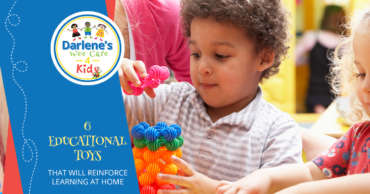
    Star builders are chunky blocks that look sort of like a 6-sided asterisk (*). With their larger size and interlocking ability, they are easy for little hands to manipulate. Your preschool child will be able to link them together to create shapes, chains, and towers, developing their motor skills and their spatial awareness.

    4. Finger Puppets

    Finger puppets (or even full-size puppets) are wonderful toys to boost your child’s imagination. Get your child started with what to do by acting out a mini-drama with finger puppets on your own hands, and let them interact and take the story wherever their imagination leads. Prepare to be amused (and amazed!) at the off-the-wall story plots your preschool child can come up with.

    5. Linking Cubes

    Linking cubes are little interlocking cubes of different colors that you can use to teach math concepts to young children. When you hear “math,” though, don’t mistake these linking cubes for “boring.” These simple cubes can engage your child’s attention for hours, and in the process, they’ll be learning skills from counting to constructing 3D shapes to developing an awareness of patterns.

    6. Dominoes

    Dominoes are another great toy for kids, and this is especially true if you get a well-made set that’s made slightly larger (to reduce the risk of choking in case they get put in mouths). Or, try the game of Quirkle for a fun alternative to dominoes that the whole family will enjoy.

    Sign up for preschool day care at Darlene’s Wee Care 4 Kids

    When you enroll your child in our day care in Upper Darby, you know that your child will be instructed, nurtured, and cared for. Start the enrollment process by contacting us today!

  • The Benefits of Active Learning for Preschoolers

    The Benefits of Active Learning for Preschoolers

    It’s well known that the right learning environment makes a big difference for preschoolers. In fact, it’s practically inconceivable to think of making a preschooler sit at a desk for hours. It simply wouldn’t work. Research has shown that preschoolers learn best when they engage in active learning that’s very similar to play. But why does this work? And how can you harness this knowledge to get the best learning outcomes for your preschool child? Here are some of the benefits of active learning for preschoolers.

    1. Movement helps knowledge stick in the brain

    Have you ever suspected your preschool child of being distracted and not paying attention because they are moving around everywhere? Actually, the opposite might be true. For children, moving the body is a critical way to help the brain to absorb new information so that it sticks. This is not just for kinesthetic learners; it’s for everyone. And it’s not just for children; it works for adults, too. Think about the last time that you sat through a long conference or seminar where the presenter didn’t give people enough breaks. It’s hard for the mind to keep learning information when you’re stiff and sore because you just want to walk around.

    How to harness this tip:

    Combine movement with learning when you work with your child. For example, do jumping jacks while you help them to practice counting, or make silly poses while you review flashcards. You’ll be amazed at how well it works.

    2. Movement helps promote brain development

    The brain of a preschool child is still developing and learning about the world, and movement is one of the big ways that helps the brain to develop. And it doesn’t just develop motor skills, coordination, and balance. It also helps to develop cognition and thinking.

    How to harness this tip:

    Guide your child through movements that cross the midline of their bodies. For example, have them touch an elbow to the opposite knee, and then switch. Also, try having them touch their hands to the opposite toe or the opposite shoulder. Crossing the midline helps to coordinate the two different hemispheres of the brain, and can help with auditory processing, writing, and using your eyes to track the words from side to side on a page.

    3. Movement helps increase a student’s interest

    When you’re interested in a subject, you can usually get much farther than when you’re bored. Interest and enthusiasm for a topic help your child to pay attention longer and focus more deeply. Looking for ways to increase their love of learning? Incorporate movement!

    How to harness this tip:

    • Dance to a silly song with your child
    • Incorporate hand movements and actions that go along with what you’re saying.
    • Create a drama or a skit to act out a story.

    When a child is getting too much screen time, they won’t naturally move around enough, and this could rob them from vital brain development and learning experiences, so do what’s available to limit their screen time and encourage active play.

    Enroll in Darlene’s Wee Care 4 Kids today

    Our day care for preschoolers is committed to providing high-quality learning experiences that make it fun to learn new things. Start the enrollment process by contacting us.

  • How Going Outside Boosts Your Preschool Child’s Development

    How Going Outside Boosts Your Preschool Child’s Development

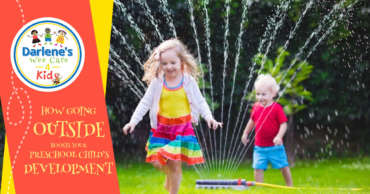
    Most of us lead indoor lives. We go from the house to the car to the store or the office. The brief moments when we breathe fresh air and feel outdoor temperatures are vastly outweighed by the amount of time we spend in our climate-controlled buildings and cars. We walk on perfectly flat floors, encounter predictable objects, and encounter a relatively low number of unusual things. All this is also true for our children. But going outside boosts your child’s development in ways that you can’t easily get any other way. Here are some of the thoughts from our preschool in Upper Darby on how lots of outside time helps your child’s development.

    Going outside boosts gross and fine motor coordination

    When your child walks on perfectly flat floors all the time indoors, their brains don’t learn about all the micro adjustments that they need to make to keep their balance. Outside, even a flat, grassy lawn has slight bumps and dips. These promote the brain’s ability to integrate the visual information from your child’s eyes with the gross motor muscle movements that they need to make to stay upright. This is even more true when your child is walking on a hill or navigating ground that has large stones.

    Fine motor coordination also happens naturally outside. It takes a lot of fine motor skill to pick a blade of grass, pluck a delicate flower, or pick up a tiny ant. If you see your child doing these things, encourage them! In the preschool years, if they develop the ability to pick up that tiny shiny rock, they’ll be ahead when they get to school and need to hold a pencil.

    Going outside provides sensory development

    When a child is indoors all the time, the only things they encounter are manufactured items. This limits the range of textures, temperatures, and smells that they will have the chance to touch, feel, and smell. Think about the materials that you can find in your home. Wood, plastic, carpet, glass, and metal don’t have the textures that you automatically find when you go outside. Your child needs the sensory development provided by shaggy grass, rough tree bark, gritty sand, a wet dog’s nose, and all the other things they’ll find outside.

    Going outside promotes your child’s imagination

    Have you ever watched a child pick up a stick and play with it endlessly, while that battery-powered singing toy only holds their attention for two seconds? What is it about the simple things you find outdoors that children love? Whatever it is, playing with a simple thing like a stick means that your child is using their imagination to make the object interesting. Developing your child’s imagination will help them all through their lives, increase their problem-solving ability, and improve their ability to play independently.

    If you’re not in the regular habit of taking your kids outside, why not start? Their brains will love it!

    Enroll in Darlene’s Wee Care 4 Kids

    Here at Darlene’s Wee Care 4 Kids, we believe in stimulating children in all the areas of their educational and physical development. Learn more about our day care and enroll your child today.

  • Preschool + Play-Doh = A Nightmare?

    Preschool + Play-Doh = A Nightmare?

    If you’ve ever worked with children and play-doh, you know what a disaster it can be. You think you’re doing something fun and amazing for your kids by getting out the play-doh, but before you know it, all the colors are mixed together into a sick color of brown, there are play-doh crumbs scattered in a radius at least 10 feet around the table, and a week later, you’re still finding play-doh chunks ground into your carpet. However, play-doh time does NOT have to be a nightmare, and you might even have fun yourself by following these tips. Check out these ideas from our preschool-age daycare teachers in Upper Darby.

    1. It starts with a mindset

    Approach play-doh time as an opportunity to spend quality time with your preschooler, NOT as a method to give them a way to entertain themselves while you do other things. Once your children are older, they’ll be able to play with play-doh unsupervised, but for smaller children, it’s just an invitation for disaster.

    2. Limit the time

    Play-doh time should last 15-20 minutes max for children of preschool age, and ideally, you should stop the activity BEFORE they are bored of it. If you sense that they are starting to lose interest at the 10-minute mark, don’t keep stretching their interest. Instead, announce that it’s clean up time and show them how to put everything away with you. Even if your child’s attention is still super-absorbed at the 20-minute mark, you’ll be teaching them a valuable life skill about how to transition from one activity to another, which will serve them later in life.

    3. Provide guidance and structure

    Here are some ground rules we’d suggest for your play-doh time:

    1. Don’t mix colors. (If necessary, only take out one color of play-doh so there’s no temptation or opportunity to mix the colors. A lesson on mixing colors can come when they’re older, but at preschool age, they will just mush all the colors together without really understanding the impact. No one wants to have only ugly brown play-doh to play with.)
    2. Don’t let the play-doh touch the floor. Explain, “We’re trying to keep all the play-doh on the table. If it touches the floor, it’ll probably get full of crumbs and hair. Gross.” Children will often try their best to comply with this if you explain the importance of it up front.

    4. Unleash their creativity

    Playing with play-doh is valuable to preschoolers’ development because it enhances their fine motor control and it improves their artistic ability (being able to visualize a 3-D shape and then model it out of clay is a very advanced skill). However, little kids have no clue how to approach play doh without your help. Start by teaching them two basic skills: How to roll a rope and how to form a ball. Practice these skills and make them fun by doing things with your rope, like winding it into a rug or making a play-doh “bowl” and filling it with play doh “peas.” Then move to more complicated pursuits, like showing them how to make a teddy bear (a large ball for the head, small balls for the ears, eyes, and nose, a ball for the belly, and logs for the arms and legs).

    Your kids will love the fact that you took the time to play with them, and you’ll set them—and yourself—up for great play-doh success. No more nightmares!

    Darlene’s Wee Care for Kids is a full-service infant and child care center offering day care, early childhood education, and a safe, nurturing environment to children from 6 weeks to 13 years old. Enroll your child today!