
Category: Blog

  • Preventing Childhood Obesity – Why Your Child Care Matters

    Preventing Childhood Obesity – Why Your Child Care Matters

    Childhood obesity affects nearly one-third of American children.

    While historically, many parents and adults did not worry about heavier weights on children — and some, in fact, claiming that it was a sign of good health — research has shown that it is in fact very unhealthy and downright dangerous. Childhood obesity sets a person up for a lifetime of struggles with weight, which directly impacts the medical health and overall quality of life. The daycare center you choose to help raise your children have a significant impact on preventing childhood obesity. Join us in today’s post as we discuss how your child care matters to your child’s nutrition.

    Quality of meals and snacks offered.

    If you are a typical working parent, your children will spend the majority of their waking hours with a child care provider. Waking hours also means eating hours. Growing children require a meal or snacks every two to three hours. This means that your daycare provider will be feeding your child a lot. Regardless of whether you send meals and snacks along with your child or the daycare provides the food, feeding your children healthy meals and snacks are important. If your daycare relies on surgery juice and canned fruit, your child is not only missing out on important nutrients and consuming a lot of unnecessary sugar, which is detrimental to their overall health and is a major contributing factor to childhood obesity.

    Promotion of healthy eating practices.

    Healthy eating practices go beyond just the foods consumed and include healthy eating settings that include hand washing, using utensils, and eating a well-rounded diet. Child care providers that rely on forcing children to eat big meals to reduce the number of feeding times are contributing to poor eating habits and can negatively influence the growth and development of your child as well as encourage childhood obesity. Food is fuel and busy children need to be recharged regularly. Additionally, a person’s stomach is only the size of their fist, so expecting a child to eat “full meals” is not realistic. Assess the menu as well as the eating practices that are encouraged at your daycare facility.

    Encouraging physical activity.

    Many daycare centers encourage physical activity because it is what children crave, and, let’s be honest, because a tired child is a well-behaved child! Be wary of any child care provider that uses television to keep a child’s attention or expects children to participate in mainly sedentary activities. Children who are taught to remain sedentary at an early age tend to be lazier and are less willing to participate in physical activity as adults. Physical activity, even that of normal play, helps your child developmentally, physically, and emotionally as well as improves motor skills, logic, and thought processing. Moving children are also at a decreased risk for childhood obesity and chronic diseases including diabetes. Make sure your child’s daycare keeps your kid moving!

    Teaching nutrition basics.

    You can give a child nutritious food and they will eat healthy for a meal, but if you teach a child about their nutrition, they will eat healthy for a lifetime! Teaching nutrition basics in an age-appropriate will help set the child up for a healthy life. Young children find plates or placemats with the food groups drawn on it helpful, whereas older school-aged children can be taught about the benefits and dangers of different foods and components.

    Because your child care provider spends more time and meals with your child than you will, it is important that they are instilling healthy lessons and behaviors in your child. At home, you can reinforce these things with healthy dinners, drinks, and snacks as well as weekend meals. But, as with anything, children learn best by example. To prevent childhood obesity, you and your child care provider should be setting healthy examples for the children in your lives. If your daycare is not promoting healthy habits, it may be time to find a new one! At Darleen’s Wee Care 4 Kids, the health and safety of the children in our care is our primary concern. We make every effort to keep your children engaged in physical activity and nourish them with healthy meals and snacks. For more information or to enroll your children, contact us today!

  • How After School Care Helps Students Succeed

    How After School Care Helps Students Succeed

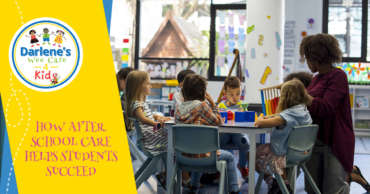
    After-school care, for most children, is viewed as little more than babysitting that covers the time the school day ends for the child and when their parents get off of work. This line of thinking causes a severe undervaluation of what a quality after-school program offers school-aged children. At Darlene’s Wee Care 4 Kids, we know what a difference that an after-school program can make for kids and take our role seriously. In today’s blog, we will highlight just a few of the ways that an after-school program can help your children succeed.

    Improve Academic Success

    Study after study, including longitudinal and meta-analysis research, suggests that even at-risk youth who were enrolled in an after-school care program achieved significant improvement in math and reading skills as compared to their peers who were not. Even after-school programs that did not offer homework or a set curriculum offered children the opportunity to learn and practice hands-on learning through play and interaction with other children.

    Prevention of Risky Behaviors

    A lack of constructive after-school care has been proven to put children at high-risk for dangerous or reckless behaviors that can cause a negative impact on their life. In an environment that lacks positive outlets for energy, school-aged children are at risk for engaging in activities that include drug and alcohol use, sexual activity, and delinquent behaviors. After school programs offer a constructive environment with age-appropriate activities for children to engage in, reducing juvenile delinquency.

    Improved Health

    After school programs can lead to improved health and overall wellness in the children who attend. After school care is usually lacking in screen time and encourages active play, which inadvertently teaches children about the importance of exercise and avoiding a sedentary lifestyle. Additionally, most after-school care includes snacks and education about different food groups and nutrition, which is invaluable in the long run.

    Social Development

    After school programs expose children to social interactions that they would not have at home alone. These interactions help develop a sense of community and establish a role within society. Interactions with peers have a significant impact on self-esteem, confidence, and body image. Socialization in childhood has been linked to success and better quality interpersonal relationships in adulthood. Interaction with other children also helps develop resilience adaptability.


    Inspire Creativity

    Social play, that is a natural occurrence in daycare centers, encourages creativity and imagination to thrive. Whether it is through free play or exposure to craft time, children in after-school care are encouraged to explore their environment and interact with other kids. Creativity and imagination are essential for growth and development and creates more successful adults.

    At Darlene’s Wee Care 4 Kids, our after-school program offers all of the benefits listed above, in a safe and fun environment. Our friendly and attentive staff is passionate about supporting young minds and facilitating positive growth and development. For more information or to enroll your child(ren) in one of our programs, call us or visit us online today!

  • Benefits of Summer Camp for Kids

    Benefits of Summer Camp for Kids

    The days are longer and the temperature is hotter. That’s right, it’s summertime, and with summer, comes one of the most enduring traditions in America — summer camp. Summer camp is a time when we meet new friends, go on new adventures, and learn new skills. At Darlene’s Wee Care 4 Kids, our summer camp sets out to give kids a fun and safe place to learn and play through these summer months. Today, we’re going to take a look at the benefits summer camp has on kids. If you’d like to learn about our summer camp program, call us today!

    -Physical Activity

    One of the most important parts of childhood development is a healthy dose of physical activity. With many kids spending their summers glued to the couch, it’s important to get them out of that sedentary lifestyle. Summer camp gives them a chance to be physically active all day. Whether it’s running, jumping, swimming, or hiking — they’re getting the exercise they need to be healthy and happy.

    -Confidence Boost

    School can be incredibly stressful for kids. Summer camp gives them a chance to succeed on their own terms, without the intense competition that can overwhelm them during the school year. With new activities and new opportunities, success can happen every day. That gives kids a much-needed confidence boost heading into the next year of school.

    -A New Resilience

    With many different new activities and a nurturing, encouraging environment, summer camp gives kids an opportunity to try new things without the fear of failure. Whether they’re enduring a setback or they’re seeing the improvement they make with each subsequent attempt, kids come out of camp with a new sense of resilience.

    -A Break from Technology

    From tablets and cell phones to game consoles and computers, kids are more connected to technology than ever before. Summer camp presents a chance to take a break from sitting in front of a screen to explore and experience the world around us. Whether it’s learning about nature or just playing around outside, sometimes, we all need a chance to unplug and engage with people in real life instead of from behind a keyboard.

    -Lifelong Skills

    Summer camp opens up a whole world of possibilities with the skills they can teach kids. Learning wilderness survival tips, how to swim, cooking, and a variety of athletic skills — this is just a small sampling of the skills kids can learn that they’ll take with them throughout their lives. With so many different activities available to them, kids can really dig in and find out more about what they enjoy.

    These are just a few of the many benefits kids can gain from going to summer camp. Friendships and social skills develop, interests blossom into hobbies, and memories are made that will last a lifetime. If you think your child would enjoy summer camp, you need to find a supportive and nurturing camp that they’ll get the most out of. Here in Upper Darby, Darlene’s Wee Care 4 Kids has a summer camp designed exactly for that. From helpful life skills to a fun place to meet other kids, we know your little one will love summer camp with us. Call us today to learn more!

  • Tips for Communicating with a Nonverbal Autistic Child: Part Two

    Tips for Communicating with a Nonverbal Autistic Child: Part Two

    We recently took a look at some ways that you can encourage communication for a nonverbal autistic child. In that post, we discussed how play, social interaction, imitation of your child’s sounds and behaviors, nonverbal communication cues, and giving them enough room to respond can help the development of communication skills. Today, we’ll be completing this two-part look at how you can help develop your child’s communication skills. If you’re in need of childcare for your special needs child, call Darlene’s Wee Care 4 Kids.

    -Simplify Your Communication

    When you make your vocabulary minimal and simplified, it not only makes it easier for your child to understand, it also makes it easier for them to imitate that speech. If your child is nonverbal, keep it to single words (i.e. if they’re playing with a ball, say “ball” or “roll”). If they have begun to speak in single words, you can increase it to a short, two-word phrase (i.e. “throw ball” or “roll ball”). Keep the “one-up” rule in mind, where you use phrases with one more word than they are using. As they gain understanding, they’ll pick more words and phrases up and their communication skills can develop.

    -Follow What They’re Interested In

    Instead of steering your child’s focus away from something that has their interest, follow along by narrating their actions. Stick to the “one-up” rule with this as you describe their actions. The verbalization of what they’re doing allows them to make the connection to their actions with their corresponding names. Learning the vocabulary associated with something they enjoy and are interested in allows them to make connections easier than if they are presented with new actions and words all at once. That can cause them to retreat inwards, avoiding communication and interaction on the whole.

    -Consider Devices and Visual Supports

    There are many types of devices and visual supports available that can help facilitate communication while fostering the development of speech skills. For example, there are some devices and apps with pictures that produce words when your child touches them. Not only does that help a nonverbal child communicate, having a visual representation of the word they are attempting to say, combined with the audio of the word playing in direct connection to them, it can help them learn the vocabulary and how to vocalize what they are hoping to say.

    While the strategies we’ve discussed in this two-part series have been successful for many parents with nonverbal and/or autistic children, it’s important to remember that every child is different. Something that may be successful for one person might not land with your child. Discuss with your child’s therapist strategies you’ve tried, what they connect with, and what they reject. They’ll be able to provide further advice depending on what is successful and what difficulties your child may be encountering. While it is a difficult situation, it’s vital to show patience to allow your child to develop at their own pace.

    If you are in the Upper Darby area and you’re looking for childcare for your special needs child, call Darlene’s Wee Care 4 Kids. We’re here to help!

  • Tips for Communicating with a Nonverbal Autistic Child: Part One

    Tips for Communicating with a Nonverbal Autistic Child: Part One

    Communicating with children can be a difficult task on its own, but it becomes even tougher with a nonverbal autistic child. However, it is possible to not only find ways to effectively communicate with them, you can also help them develop their verbal skills in a way that is comfortable to them. With that being said, it’s important to remember not all autistic children are the same. While one strategy may work perfectly for one situation, that’s not to say it will be right for another. In hopes of improving communication skills, we have put together this list of ways you can help a nonverbal autistic child communicate. If you are in need of childcare that doesn’t leave behind children with special needs, call Darlene’s Wee Care 4 Kids.

    -Play and Social Interaction

    Much of any child’s education comes as a product of playing, including learning language and communication skills. Find games that your child enjoys playing to engage them. Include activities that encourage social interaction, such as singing and reciting nursery rhymes. While you’re interacting with your child, keep yourself in front of them and close to eye level, as that will make it easier for them to see and hear you.

    -Mimic Your Child

    Pay attention to the sounds and behaviors your child makes while interacting. You can help them be more vocal by imitating the sounds they make, while encouraging them to copy you and take turns going back and forth with sounds. Only imitate their behavior when it is a positive action. For instance, if they roll a toy car, you roll yours as well. But, if they throw their car, don’t follow suit. This is an opportunity to show them good behavior first hand.

    -Nonverbal Communication

    Small things like gestures and eye contact can help an autistic child form the foundation for future language and communication skills. Exaggerate your gestures to get your communicate your feelings to them. Use your voice and body while communicating, such as extending your hand and saying the word “look”. Observe your child’s gestures and respond to them in kind. When they see you communicating like this, they will be more likely to use this technique to communicate with you and others.

    -Give Them Space to Talk

    When talking to your child, it is easy to feel like you need to help them along when they don’t respond right away. This can make them more shy about answering since they feel like you’ll answer for them. When you ask them a question, give them ample time to answer while watching expectantly. Keep an eye out for any sounds they make or nonverbal gestures, as this may be the only way they can respond at that time. Then, respond to that gesture promptly to help them establish the flow of communication.

    That wraps up part one of our look at some ways you can help a nonverbal autistic child communicate. We’ll be diving into part two in a couple of weeks, but we hope these strategies help you with your little one. If you’re looking for childcare services in Upper Darby that will give your special needs child the attention and care they deserve, call Darlene’s Wee Care 4 Kids. We’re here to help!

  • Sensory Processing Disorder Meltdown

    Sensory Processing Disorder Meltdown

    Darlene’s Wee Care for Kids, in Upper Darby is a Top Rated Local® child care facility who offers services for special needs children. We can work with deaf children, as well as children with Autism or physical handicaps, who are developmentally delayed, and who have other special needs. Call us today for a tour of our facility.

    Every parent knows that meltdowns come with the territory. They can happen anywhere and at any time and for any reason. Maybe you were the worst parent ever and cut their sandwich just the way they usually like it, maybe you told them they can’t eat the soap. Their little bodies don’t seem to be able to contain the bewildering emotions that wash over them at any moment.

    As they grow older they typically grow out of meltdowns (until they are teenagers when they have new, more fun ones!), but sometimes a meltdown is more than a just meltdown, it’s a sign of something else going on. Young children can’t express themselves accurately because they are little and just learning all the words for emotions and learning to understand their experiences. Sometimes there is a sign of sensory processing issues that might not be diagnosed until later. This week we’ll discuss what sensory processing disorder is and what it can look like at different ages.  We’ll cover some coping strategies and home therapy tips in upcoming blogs.

    All of our senses are based on signals from the body to the brain, through the nervous system, be they smell, sight, touch, all stimulation is processed by the brain. According to the Star Institute, “Sensory Processing Disorder (SPD), exists when sensory signals are either not detected or don’t get organized into appropriate responses.” This can mean that the child either seeks out certain stimuli, avoids certain stimuli, or becomes easily overwhelmed when experiencing too much, or too little stimuli. Because this can clearly go in any direction, it can be hard to diagnose.

    [uxi_button link=”//www.darlenesweecare4kids.com/contact-us/?uxi_preview=1″ new_window=”0″ tel=”1″ class=”button-block button-block-mobile button-32″ padding_x=”” padding_y=”” text=”Get Started! ” text_size=”14″ text_size_mobile=”” text_font=”header-font” sub_text=”” sub_text_size=”12″ sub_text_size_mobile=”” sub_text_font=”header-font” icon=”” icon_size=”12″ icon_size_mobile=”” icon_align=””]

    What it Looks Like at Different Ages

    According to Understood, an infant with SPD might not like to be held tightly, may be overly fussy, or may need to be constantly held. A toddler doesn’t like certain fabrics or shoes, or tags, for example, has more meltdowns than an average toddler. One remarkable sign in toddler and preschoolers is that they are easily overwhelmed in groups. This is relative and dependant on an individual child. Some children may find three children too many if it’s in an already stimulating context such as a ball pit/ They may react by melting down or acting inappropriately. A grade-schooler may have trouble making friends because they are awkward, they play roughly. They may have fine motor skills that, for example, makes penmanship difficult. Check back for future blogs for more information on this topic.
    When you are looking for a daycare that is sensitive to your child’s needs, be they diagnosed or not, turn to Darlene’s Wee Care for Kids. We have staff that knows ASL and that have experience working with children who face challenges of all types. Call us today to schedule a tour of our facility.